
2024 was the year Twitch badge collecting truly grew from a niche interest into a visible community trend. Users started tracking releases, forming groups, and treating badges as something worth actively chasing.
2025 was the year Twitch noticed – and leaned in.
Instead of simply releasing a few event-related badges, Twitch began using them deliberately: to guide behavior, support monetization, encourage social sharing, and structure long-term engagement. The numbers alone show how dramatic that shift was.
By the end of 2025, Twitch had released 80 badges. In 2024, there were 19.
Scale tells the story
Looking at the raw categories makes the change hard to ignore.
In 2024, Twitch released:
- 9 free badges
- 7 payment-related badges
- 3 special badges
In 2025, those numbers became:
- 22 free badges
- 43 payment-related badges (subscriptions, charity, TwitchCon)
- 13 special / system badges
Special badges
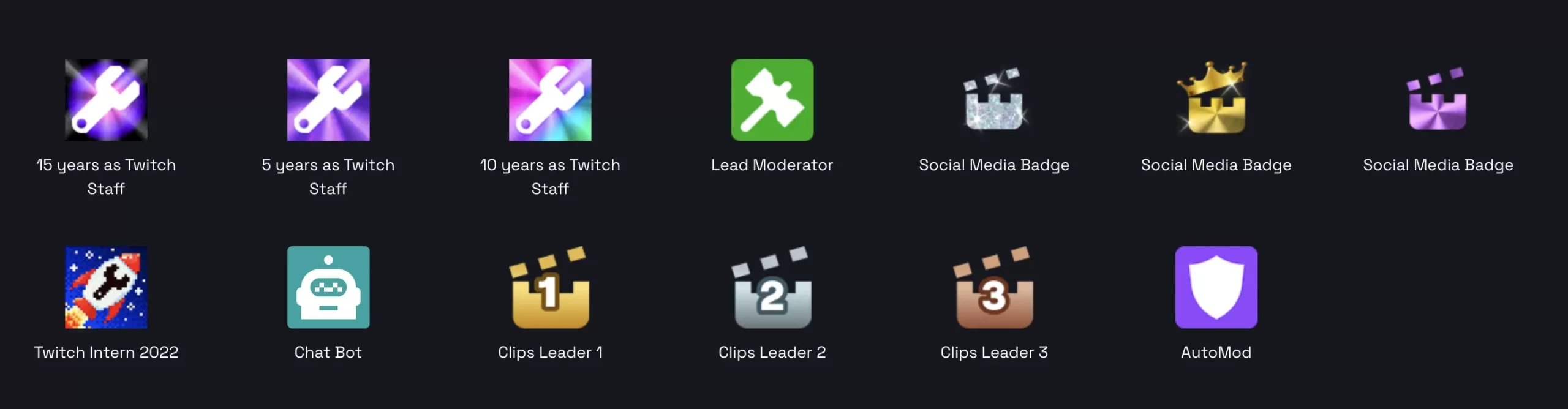
In 2024, special badges were rare and mostly symbolic. In 2025, they became a clearly defined layer of the system: 13 badges, many of them tiered or role-based.
These included badges tied to moderation, staff tenure, automation, and social activity (for example: Lead Moderator, Clip Leader levels, Social Media Badge levels, Twitch Staff 5/10/15 years).
Twitch started visually separating roles and experience levels, reinforcing hierarchy and long-term participation. Badges stopped being only “things you get” and became markers of who you are on the platform.
Free badges: more than last year, but with a new purpose
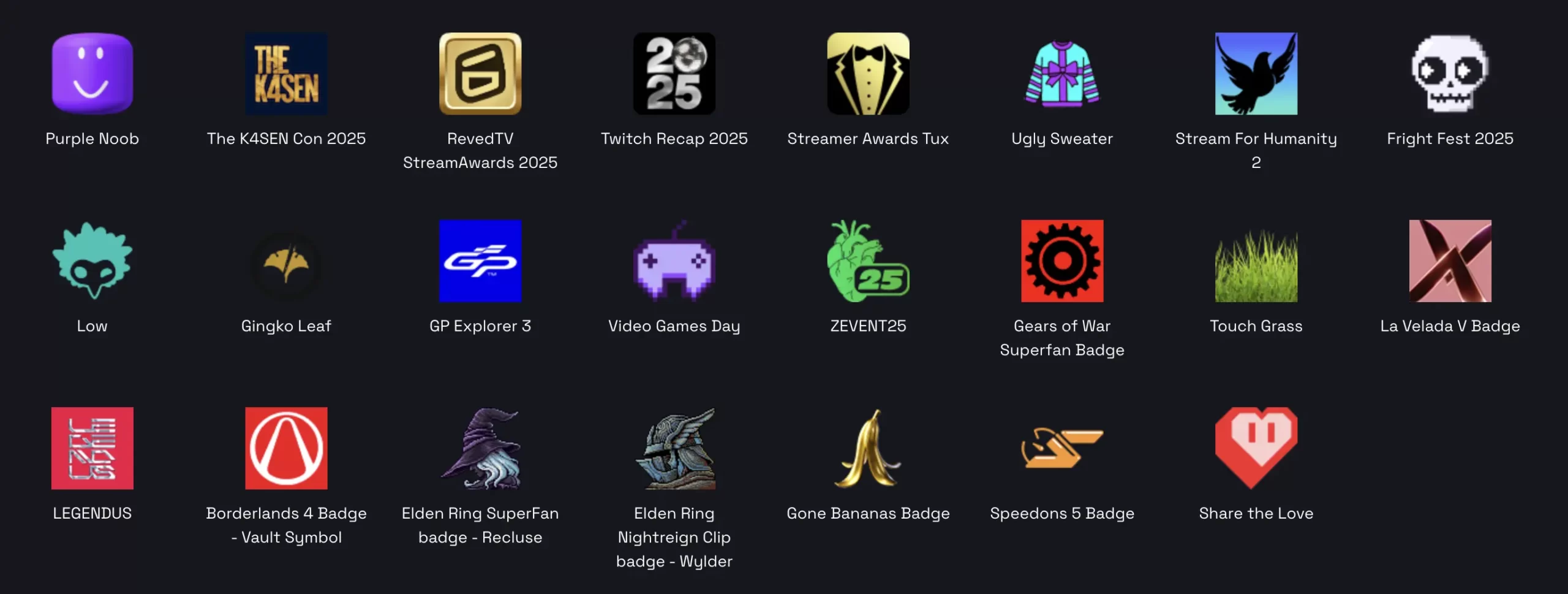
Free badges still mattered in 2025 – there were 22 of them, compared to 9 in 2024 – but their role shifted.
A large portion of free badges was tied to clip creation and sharing. Seven different badges required users to spread Twitch content outward (for example: Share the Love, Gone Bananas, Fright Fest 2025, Ugly Sweater).
This is more than double the number of clip-driven free badges from the previous year.
And this trend is reinforced by other actions taken by Twitch to strengthen the culture of clips.
Other free badges remained tied to major broadcasts and cultural events (such as La Velada V, ZEVENT25), reinforcing the idea of annual badge series – something that only began to form in 2024.
There was also just one badge tied to actually streaming yourself (Elden Ring SuperFan – Recluse), which highlights where Twitch’s main focus was. But that’s fair, as users who don’t have the ability to stream also want to receive their badges.
Paid badges: the center of gravity in 2025
The biggest change came with paid badges.
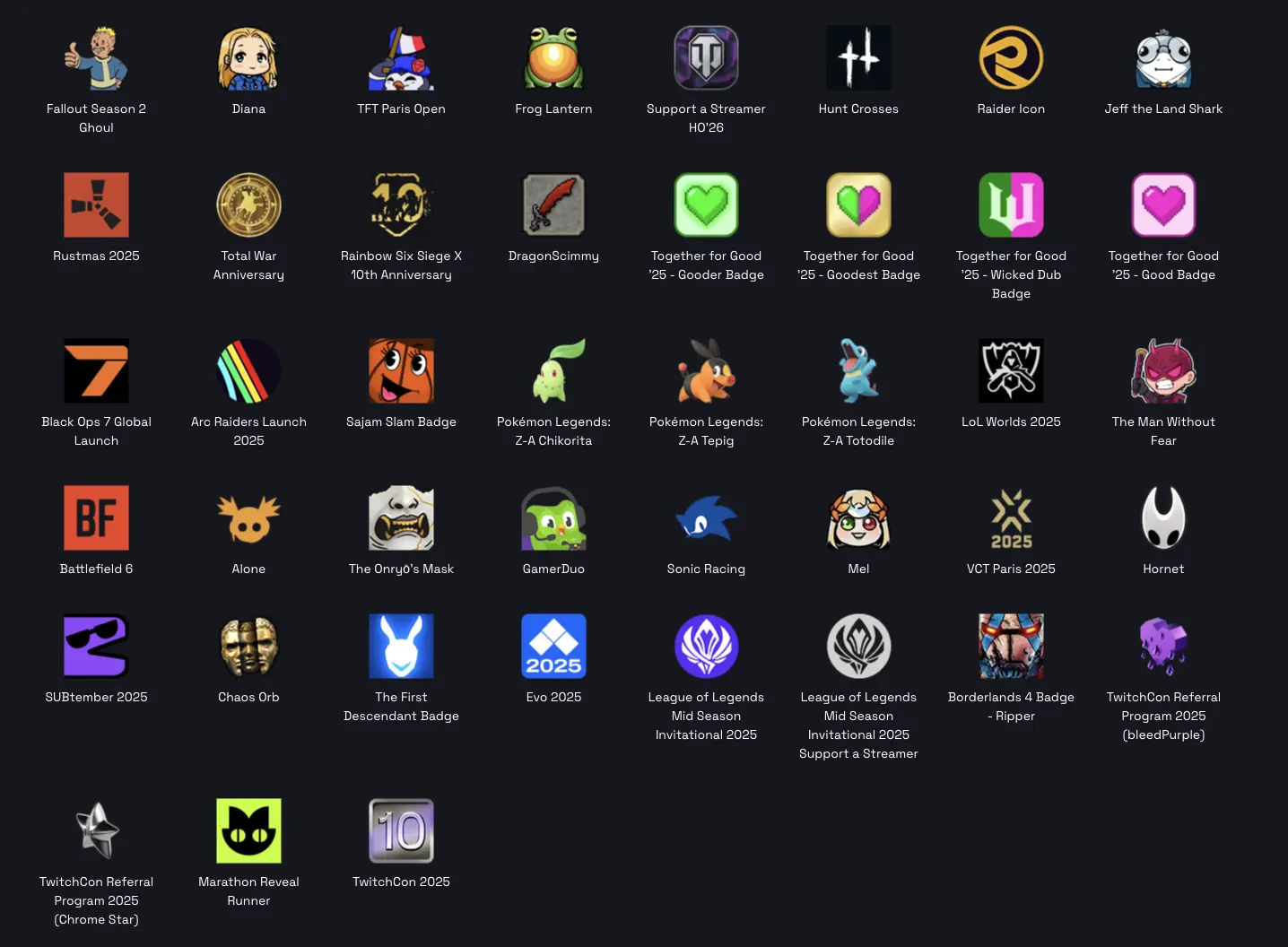
In 2024, there were 7 badges tied to payments. In 2025, that number jumped to 43.
Most of these were subscription-based, often linked to launches, esports events, or limited campaigns (for example: SUBtember 2025, Hornet, The Onryō’s Mask, Hunt Crosses).
What made 2025 different wasn’t just volume, but complexity.
For the first time:
- The same subscription badge returned in multiple periods (Borderlands 4 – Ripper, available months apart).
- Some badges required more than one subscription (TFT Paris Open needed 2, Frog Lantern needed 3).
At certain points in the second half of the year, there were five or more paid badges active at the same time. That level of overlap simply didn’t exist in 2024.
The second-half surge – and its effect on collectors
Another clear pattern emerges when looking at timing.
Most of the badge expansion happened in the second half of 2025 entirely changing the experience of collectors.
In 2024, missing a badge usually meant missing information. In 2025, missing badges often became a deliberate decision.
Many collectors stopped trying to get everything. Some focused only on free badges. Others dropped collecting altogether. For some of them badges lost value, for others – keeping up became expensive and time-consuming.
This shift in behavior is one of the most important outcomes of the year.
Edge cases
Not everything scaled cleanly.
One notable example was Survival Cup 4: a badge that appeared in the API and database, but was never obtainable because it was cancelled. It remained technically present, but practically unreachable.
Tracking badges became its own ecosystem
As badge releases accelerated, so did the need to follow them.
In 2025, several 24/7 badge-tracking Twitch channels appeared, dedicated entirely to monitoring new releases, availability windows, and requirements.
I also launched my own badge-focused Twitch channel this year to help collectors navigate an environment that now changes constantly.
The existence of these tools is itself a signal: badges are no longer simple enough to track casually.
Conclusion
Compared to 2024, 2025 wasn’t just bigger – it was intentional.
Badges evolved into:
- a monetization layer,
- a distribution incentive,
- a long-term engagement system.
I think that, ultimately, all these experiments with badges were successful for Twitch, but they significantly affected some users. Let’s see what 2026 brings us.
Thank you for spending time with BadgeBase in 2025. More to come!